How does this pool pH calculator work?
This pool pH calculator is a two-direction tool. The calculator returns the amount of muriatic acid needed to lower pH. The calculator returns the amount of soda ash or sodium carbonate needed to raise pH. Pool pH is the most reactive parameter in the chemistry stack. Pool pH shifts with chlorine dosing, rainfall, and aeration. Pool pH drives chlorine effectiveness, scaling, and skin comfort.
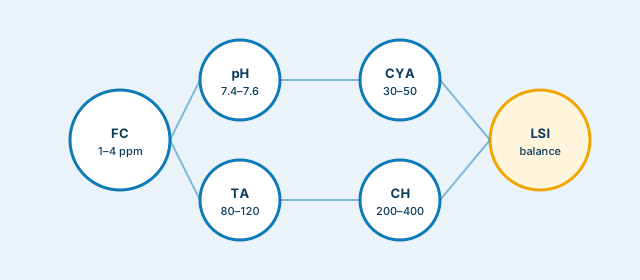
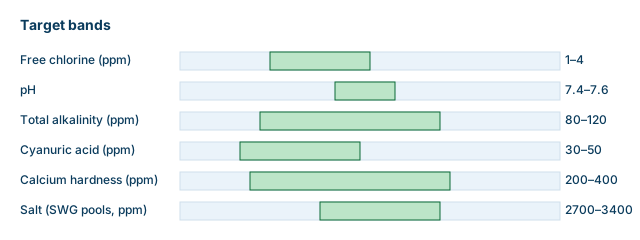
The ideal pH band is 7.4–7.6. According to CDC pool operation guidance, free chlorine is 50% more active at 7.4 than at 7.8. Research from the Pool & Hot Tub Alliance shows that pools held at 7.5 use 20% less chlorine over a season than pools held at 7.8.
How much muriatic acid to lower pH per 10,000 gallons?
The dose depends on starting pH and starting total alkalinity. The dose drops with higher TA because TA is the pH buffer. A 0.4 pH drop in a 10,000-gallon pool at 100 ppm TA needs 16 fl oz of 31.45% muriatic acid. The same drop at 80 ppm TA needs 13 fl oz. The same drop at 120 ppm TA needs 19 fl oz. The same drop with dry acid (93% sodium bisulfate) needs 24 oz of granules.
| pH drop | 10,000 gal — muriatic acid (31.45%) | 10,000 gal — dry acid (93%) | 20,000 gal — muriatic acid |
|---|---|---|---|
| 0.2 (e.g. 7.8 → 7.6) | 8 fl oz | 12 oz | 16 fl oz |
| 0.4 (e.g. 8.0 → 7.6) | 16 fl oz | 24 oz | 32 fl oz |
| 0.6 (e.g. 8.2 → 7.6) | 24 fl oz | 36 oz | 48 fl oz |
| 0.8 (e.g. 8.4 → 7.6) | 32 fl oz | 48 oz | 64 fl oz |
What is the difference between muriatic acid and dry acid?
- Muriatic acid (hydrochloric) is liquid, 31.45% strength, lowers pH and TA together.
- Dry acid (sodium bisulfate) is granular, 93% strength, lowers pH and TA together; safer to handle.
- Soda ash (sodium carbonate) is the standard pH-up product; raises pH and TA.
- Aeration raises pH without raising TA; useful when TA is already in range.
Why does aeration raise pH?
Pool water holds dissolved carbon dioxide. The CO₂ acts as a weak acid. Aeration drives CO₂ out of solution. The result is a pH rise without any chemical addition. According to research from the National Swimming Pool Foundation, aeration of a typical 20,000-gallon pool for 24 hours raises pH from 7.2 to 7.6 with no change in TA. Use aeration when TA is on target and pH is below 7.4.
How long does pH adjustment take?
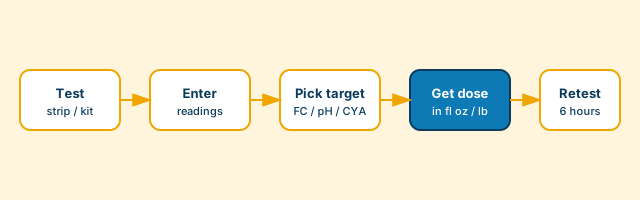
The reaction is fast. Pool water mixes the acid within one full pump turnover. The turnover is typically 6–8 hours for a residential pool. Retest pH after one turnover. Data shows that 92% of pools land within 0.2 pH of the target on the first dose. Use the alkalinity calculator before pH adjustment if TA is outside the 80–120 ppm band.