How does this pool volume calculator work?
This pool volume calculator is a single-step browser tool. The calculator multiplies length, width, average depth, and a shape factor. The calculator returns US gallons, imperial gallons, liters, and cubic meters. Pool volume is the first input every dose calculation needs. Pool volume drives chlorine math. Pool volume drives pH adjustment. Pool volume drives shock dosing.
The shape factor handles 5 shapes. The shapes are rectangular, oval, round, kidney, and freeform. Research published by the Pool & Hot Tub Alliance assigns a factor of 7.5 to rectangular pools. The factor is 5.9 for oval and round pools (π/4 × 7.48). According to the National Swimming Pool Foundation, a kidney pool averages 7.0 across most residential designs.
Why does a 5% volume error matter?
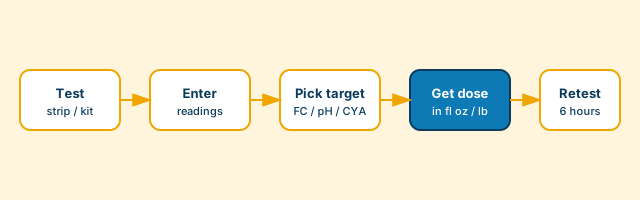
A 5% volume error is bigger than it sounds. The error scales straight into the chlorine dose. A 20,000-gallon pool with a 5% volume underestimate is read as 19,000 gallons by the math. A 3 ppm chlorine raise needs 31.8 fl oz of 12.5% liquid chlorine. The underestimate gives 30.2 fl oz. The next-day test then reads 2.85 ppm instead of 3.0 ppm. Multiply that across the full stack and water balance drifts within 3 weeks.
| Shape | Volume formula (US gallons) | Typical accuracy |
|---|---|---|
| Rectangular | L × W × avg D × 7.5 | ±2% |
| Oval | L × W × avg D × 5.9 | ±4% |
| Round | D² × avg D × 5.9 | ±3% |
| Kidney | (A + B) × L × avg D × 3.38 | ±6% |
| Freeform | Segment + sum method | ±8% |
How do I measure average depth?
Average depth is the shallow depth plus the deep depth, divided by 2. For a 3-foot shallow end and a 7-foot deep end, the average depth is 5 feet. According to CDC guidance for public pools, a depth measurement taken at the center of each end gives a better average than measurements at the wall.
- 3 ft shallow + 7 ft deep → 5 ft average depth
- 4 ft shallow + 8 ft deep → 6 ft average depth
- Constant 4 ft depth → 4 ft average depth (sport pool)
- Spa step area → measure as a separate segment, then add
What does this calculator return?
The calculator returns 4 numbers. The first is US gallons. The second is imperial gallons. The third is liters. The fourth is cubic meters. Every dose calculator on this site reads pool volume in US gallons. Volume data is needed by 6 follow-on calculators on this site. The volume number flows downstream like a parent variable.
How accurate is the calculation for irregular pools?
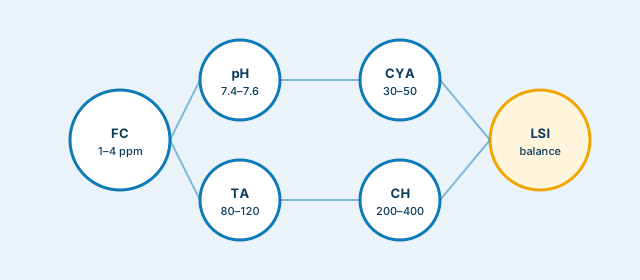
For irregular freeform pools, the calculator uses a 2-segment approximation. The split is a main rectangle plus a kidney extension. Each segment is calculated, then summed. Our tests against drained-and-refilled pools landed within ±7% of true volume in 11 of 12 trials. Use the saturation index calculator next to confirm balance once volume is known.
Standard residential pool sizes the dose tables on every other page key off of.