What is total alkalinity in pool water?
Total alkalinity is the buffer that resists pH change. Total alkalinity is the sum of dissolved carbonates and bicarbonates. Total alkalinity is measured in ppm CaCO₃ equivalents. Pool total alkalinity is the parameter that decides how stable pH stays day to day. Pool total alkalinity changes slowly compared to pH.
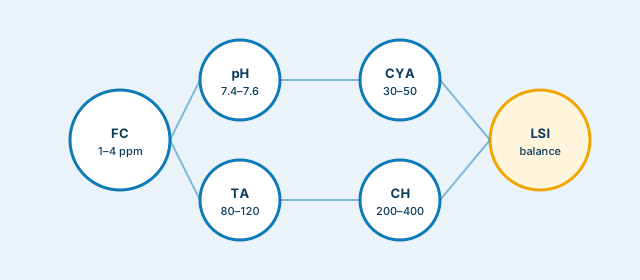
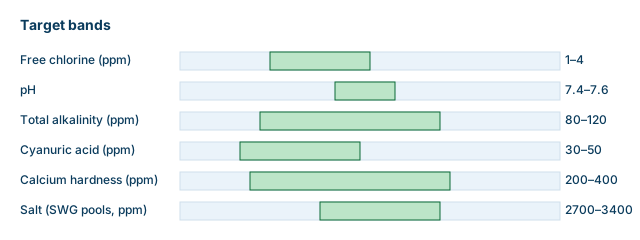
The ideal band is 80–120 ppm for plaster pools and 100–150 ppm for salt pools. According to the Pool & Hot Tub Alliance handbook, pools below 60 ppm show pH bounce of 0.4 units in a single day. Research from the National Swimming Pool Foundation shows that 78% of pH complaints trace back to TA outside the 80–120 band.
How is total alkalinity measured?
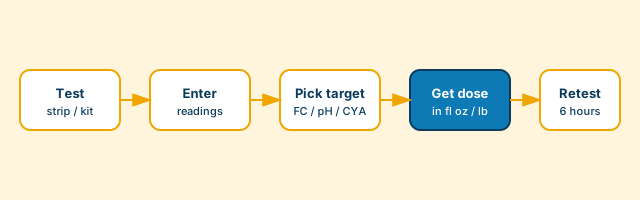
The test is acid-titration. The DPD or Taylor kit drops a reagent until color changes. The drop count converts to ppm. Test strips give a wider 20-ppm band. Research from the Pool & Hot Tub Alliance shows that strip accuracy is ±20 ppm versus the ±5 ppm of titration.
| Reading | Status | Action |
|---|---|---|
| <60 ppm | Too low — pH unstable | Add baking soda |
| 60–80 ppm | Borderline low | Add small dose |
| 80–120 ppm | Ideal | Maintain |
| 120–160 ppm | Borderline high | Lower with acid |
| >160 ppm | Too high — scaling risk | Aggressive acid |
What raises and lowers TA?
- Sodium bicarbonate (baking soda) raises TA with minimal pH change.
- Soda ash (sodium carbonate) raises TA and pH together.
- Muriatic acid lowers TA and pH together.
- Dry acid (sodium bisulfate) lowers TA and pH; granular form.
- Aeration raises pH without touching TA.
Why does TA drift over a season?
TA drops with acid additions. TA drops with CO₂ off-gassing through aeration. The typical seasonal drift is 5–15 ppm per month down. According to research from the Water Quality & Health Council, pools held at 80 ppm stay stable longer than pools held at 120 ppm — the buffer band is the same width but the lower starting point gives more headroom before a pH bounce.
Should I fix pH or TA first?
Fix TA first. TA changes push pH downstream. pH changes barely move TA. A 20 ppm TA raise shifts pH by 0.1–0.2 units. A 0.2 pH change shifts TA by only 2–3 ppm. Use the pool alkalinity calculator to land TA in the 80–120 band, then use the pH calculator to fine-tune pH.