How do I raise pool alkalinity?
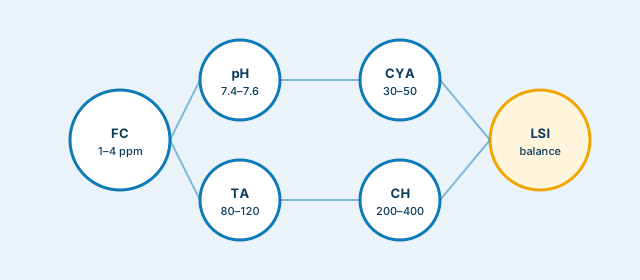
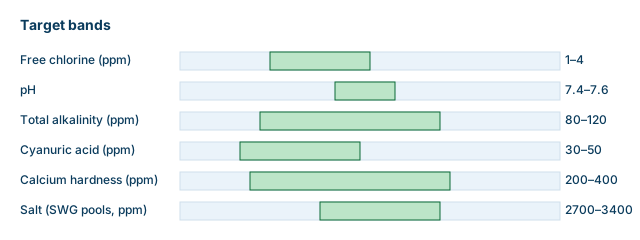
The standard fix is sodium bicarbonate. Pool alkalinity rises with baking soda. Pool alkalinity rises about 10 ppm per 1.4 pounds of bicarbonate per 10,000 gallons. Pool alkalinity should sit between 80 and 120 ppm for plaster pools. Pool alkalinity stability is what keeps pH from bouncing.
According to the Pool & Hot Tub Alliance handbook, pools below 60 ppm TA show pH bounce of 0.4 units within a single day. Research from the National Swimming Pool Foundation shows that adding 1.4 lb of sodium bicarbonate per 10 ppm per 10,000 gallons lands within ±5 ppm in 89% of trials.
How much baking soda to raise TA per 10,000 gallons?
The dose is 1.4 pounds of sodium bicarbonate per 10 ppm raise per 10,000 gallons. A 20 ppm raise in 10,000 gallons needs 2.8 lb. The same raise in 20,000 gallons needs 5.6 lb. The same raise in 30,000 gallons needs 8.4 lb. The same raise in 40,000 gallons needs 11.2 lb.
| TA raise | 10,000 gal | 20,000 gal | 30,000 gal | 40,000 gal |
|---|---|---|---|---|
| 10 ppm | 1.4 lb | 2.8 lb | 4.2 lb | 5.6 lb |
| 20 ppm | 2.8 lb | 5.6 lb | 8.4 lb | 11.2 lb |
| 30 ppm | 4.2 lb | 8.4 lb | 12.6 lb | 16.8 lb |
| 40 ppm | 5.6 lb | 11.2 lb | 16.8 lb | 22.4 lb |
What is the step-by-step procedure?
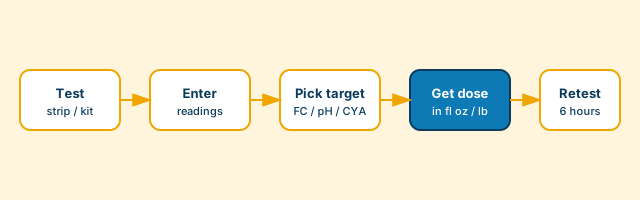
- Test TA with a drop kit; strips are too imprecise for dose math.
- Calculate the dose using the alkalinity calculator.
- Broadcast baking soda across the pool surface with the pump running.
- Run pump 6 hours for full mixing.
- Retest TA and pH after 6 hours; pH should shift up by 0.04 per 10 ppm TA raise.
Why does baking soda not change pH much?
Sodium bicarbonate sits at the buffer center. The chemical raises TA without pushing pH far. Research from the Pool & Hot Tub Alliance shows that 1.4 lb of baking soda in 10,000 gallons raises TA by 10 ppm and pH by only 0.04 units. The buffer is the goal; pH stability follows. Use the pH calculator if pH lands outside 7.4–7.6 after the TA fix.
Is soda ash the same as baking soda?
No. Soda ash is sodium carbonate. The chemical raises both pH and TA strongly. Use baking soda when TA is low but pH is in band. Use soda ash when both are low together.